
QC Trade-Offs on a Luxury Fragrance Line With Vegan Claims
Quality control on a high-end fragrance line is not a single standard that can be maximised everywhere. It is a set of trade-offs, and each one buys something at a cost elsewhere. Sensory precision costs line speed, deeper documentation costs flexibility, decorative complexity costs yield, and vegan material assurance costs both money and lead time. The useful question for a brand is not which standard is highest, but which trade-offs match the promise the product is actually making.
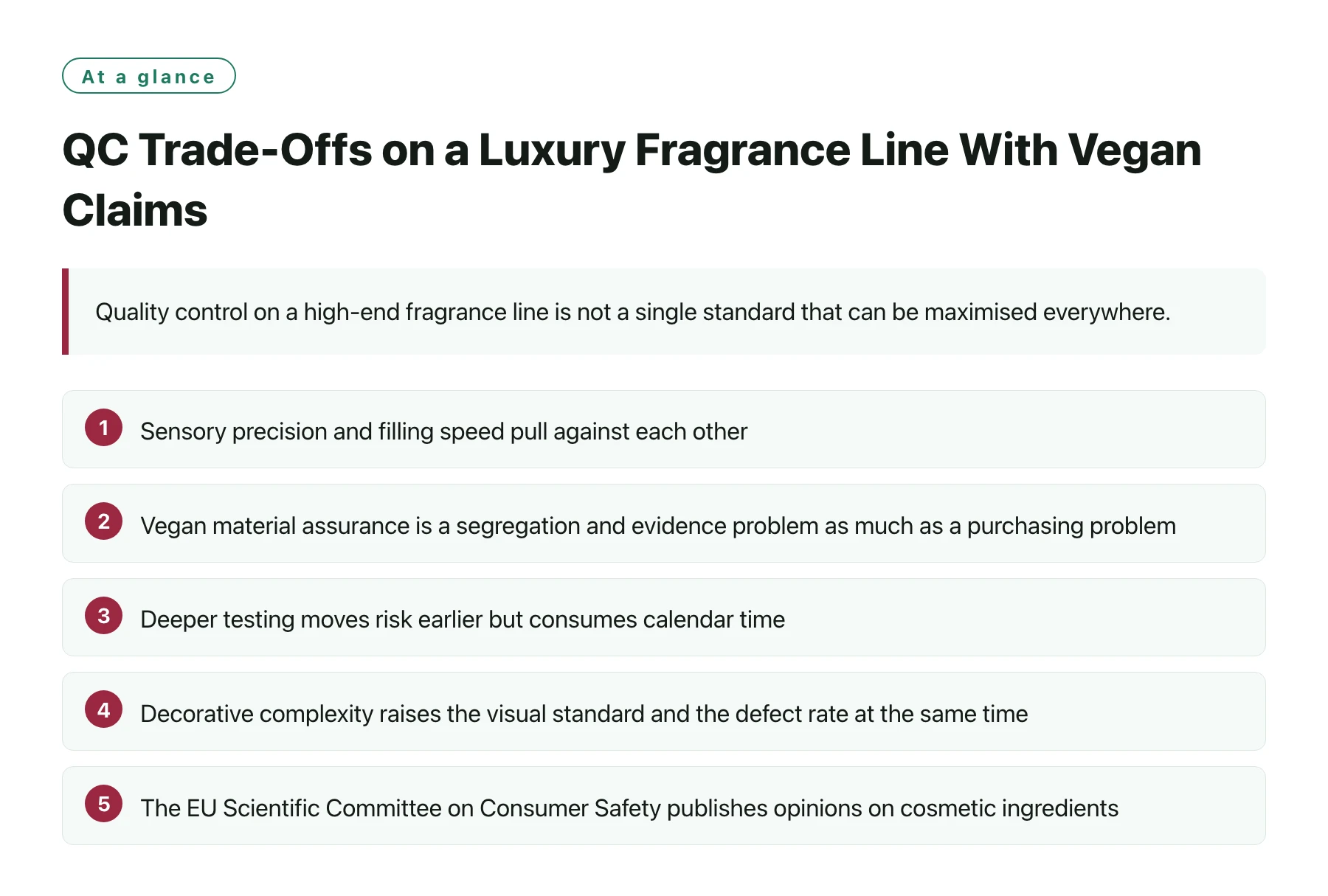
Key takeawaysSensory precision and filling speed pull against each other, because tighter sensory acceptance usually means slower lines, smaller batches and more held units. · Vegan material assurance is a segregation and evidence problem as much as a purchasing problem, and it is strongest where material lots are traceable to individual batches. · Deeper testing moves risk earlier but consumes calendar time, which is why the tests that gate the launch should be separated from the tests that inform future orders. · Decorative complexity raises the visual standard and the defect rate at the same time, so decoration should be chosen with the yield in mind rather than only with the photograph. · The EU Scientific Committee on Consumer Safety publishes opinions on cosmetic ingredients, and those opinions form part of the evidence base for ingredient decisions in that market [1]. · Third-party laboratories set out the scope of the cosmetics testing they offer, which makes it easier to see which checks are standard and which are project-specific [2].
High-end fragrance work is often discussed as if quality were a dial. Turn it up and everything improves. In practice, the dial is really a set of linked decisions, and moving one of them changes the cost, the speed and sometimes the risk profile of the others.
This article is written for a quality or operations lead who has to defend those decisions to a commercial team. It sets out four trade-offs and the criteria for choosing between them, with a note on what a vegan positioning changes.
Why 'higher quality' is not a single decision
A luxury positioning usually means the brand cares about three visible things: the scent behaves consistently, the pack feels considered, and the product arrives in perfect condition. Each of those depends on a different part of the production system, and tightening one does not automatically tighten the others.
The practical consequence is that a quality discussion should start from the promise rather than from the specification. A brand selling a single hero scent at a high price point can justify slower lines and tighter sensory gates. A brand shipping a wide range through many channels may need a different balance, because the same tightening applied across a large range can price the product out of its market.
It is also worth separating the checks that protect the customer from the checks that protect the schedule. Both are quality work, but they belong in different conversations and often in different budgets.
Four trade-offs and what each one buys
| Decision | What it protects | What it costs |
|---|---|---|
| Tighter sensory acceptance gates | Consistency of the scent the customer receives | Line speed, yield and the number of units held for review |
| Full lot traceability for vegan materials | The ingredient position the brand is selling | Purchasing flexibility, because substitute lots cannot be used without a decision |
| Extended testing before release | Fewer surprises after the product is in market | Calendar time on the critical path, and sometimes additional sample quantities |
| Complex decoration and premium components | The perceived quality of the pack | Defect rate, rework and the amount of inspection the pack requires |
None of the four is wrong. The failure mode is choosing all four without deciding which one the brand is willing to pay for when they conflict.
Trade-off one: sensory precision against line speed
The scent is the product, so sensory control sits at the centre of any high-end line. The tension appears at scale. Compounding a large batch introduces small variations in mixing, temperature and maceration time, and the narrower the acceptance window, the more of those variations fall outside it.
A brand can respond in two ways. It can widen the window and accept more variation, or it can narrow the production parameters, which usually means smaller batches, slower filling and more frequent in-process checks.
The decision should follow the channel. Where a customer can compare two bottles side by side, consistency is worth a slower line. Where units are sold individually across a long period, small batch-to-batch variation is far less visible, and the money may be better spent on the pack or on testing.
Where vegan sourcing changes the sensory picture
Vegan specifications rarely change the main accord, but they can change the supporting materials, and supporting materials are what hold a scent together over time. A substituted fixative may be perfectly acceptable on day one and behave slightly differently after a few months. That is a reason to test the vegan version of a formula in its final pack, not only as a concentrate.
Trade-off two: assurance against flexibility
A vegan claim is a statement about what is not in the product and about the materials that were used instead. Both halves need evidence, and evidence in this context means material records that connect to the finished units.
The cost is flexibility. A factory that can swap a material lot when a delivery is late gains schedule resilience, but on a vegan line that swap has to be checked against the exclusion list and documented. Building that check into the process slows purchasing down slightly and prevents the more expensive problem of shipping a product that does not match its claim.
Segregation matters as much as documentation. If materials are stored and dispensed without a clear separation between a vegan specification and other work on the same site, the record may be accurate while the physical control is weak. Asking how dispensing is controlled is a more revealing question than asking whether the factory can supply vegan materials.
The most cost-effective approach is usually to define the exclusion list narrowly and precisely, then hold it stable. A short list that is genuinely enforced is more defensible than a long list the factory cannot fully evidence. Where a brand needs outside assurance on the safety side of ingredients, the opinions published by the EU Scientific Committee on Consumer Safety are one part of that evidence base [1].
Trade-off three: testing depth against launch timing
Testing is the clearest example of a trade-off with a calendar attached. Compatibility testing, stability checks and microbiological work all take time, and some of them cannot begin until the formula is fixed in its final container.
The second variable is scope. A laboratory will test what it is asked to test, and third-party providers publish the scope of the cosmetics testing they offer so that brands can see the difference between a standard panel and a project-specific one [2]. Paying for tests nobody will read is as poor a decision as skipping one that a retailer will ask about.
A workable approach is to split testing into two groups. The first group gates the launch: the minimum evidence the destination market and the channel require. The second group informs improvement: longer-term stability, additional compatibility, and studies that make the next order easier. Only the first group belongs on the critical path.
There is also an accumulation effect worth noting. Formulation and testing practice changes over time, and industry coverage of those changes is one way to keep the second group current without commissioning unnecessary work [3].
Trade-off four: decoration against yield
Decoration is where a high-end line most often overreaches. Every additional process step adds visual value and adds a failure mode. Coating, foil, print passes and secondary packaging each carry their own defect rate, and defects on a decorated component are usually not repairable.
The discipline that helps is to decide the decoration after the yield has been estimated, and to treat each step as needing a justification rather than as a default. A pack that looks expensive because of the glass and the weight can often carry a simpler decoration than a pack that is trying to look expensive through print.
Component quality also interacts with logistics. A heavier or more fragile pack raises freight cost and handling loss, which shows up as a quality problem even though it originated in a design decision.
Choosing the balance, and evidencing it
A brand that has agreed which trade-offs matter can translate them into a short list of acceptance criteria, which is a far more useful document than a general aspiration to produce a premium product. Acceptance criteria can be checked, argued about and improved.
The supplier side of the question is whether the factory can hold the criteria consistently. Looking at how a partner describes luxury fragrance OEM services is a starting point, and asking for the checks behind each stage is more informative than asking for a capability statement.
Fit matters too. A manufacturer positioning itself for a manufacturer for luxury fragrance brands is usually organised around smaller batches and tighter gates, while a supplier built for volume works differently. Neither is better in the abstract; one will match the trade-offs above and the other will not.
Finally, the trade-offs should be revisited before signing. A structured set of questions, of the kind used for due diligence on a perfume manufacturer, surfaces whether the factory's actual practice matches the criteria the brand believes it has agreed.
Write down the one trade-off you are not willing to lose. If sensory consistency is non-negotiable, accept the slower line. If the launch date is non-negotiable, accept a wider window. A quality plan without a declared priority will be resolved by whoever is under the most pressure on the day.
Sources
- EU Scientific Committee on Consumer Safety (SCCS) —— The EU scientific committee that issues opinions on the safety of cosmetic ingredients, including fragrance allergens and their labelling thresholds.
- SGS: Cosmetics, Personal Care & Household Testing —— Testing, inspection and certification services for cosmetics and personal care, including microbiological, stability and safety testing aligned with cosmetics GMP.
- Cosmetics & Toiletries —— A technical magazine for cosmetic formulators, covering ingredients, formulation science and testing methods.
Frequently asked questions
Does a vegan claim require different quality controls from a standard line?
The controls are the same in kind, but the material assurance is tighter. You need lot-level records for the materials used, a clear exclusion list and a rule for what happens when a substitute is proposed. The scent itself is usually unaffected.
How many batches should be tested before a first launch?
Enough to see variation rather than a single result. Testing one batch tells you the product can meet the specification; testing more than one tells you whether it reliably does. The number depends on the format, the channel and the tests involved.
Is a slower line always better for a luxury product?
No. Slower lines usually improve consistency and reduce rejects, but they also change the economics of the order. Where the product is sold individually, spending that money on the pack or on testing may serve the brand better than tightening the line further.
What is the strongest evidence that a vegan claim is being honoured?
Material records that connect to the shipped units, supported by a defined exclusion list and a documented substitution rule. A certificate covering the factory overall is weaker, because it does not show which materials went into which batch.
How should decoration decisions be linked to quality?
By costing the yield before approving the design. Each additional decoration step adds a failure mode, and decorated components are often unrepairable. A simpler decoration on a strong component frequently reads as more premium than a complex one that generates rejects.